

If AI can already write the article, why does it need your website at all?
Most new content published today isn’t written by a person, it’s written by AI.
74% of new web pages now carry AI-generated content
(Ahrefs, 900K pages, April 2025).
And the other shoe just dropped.
Search traffic to content sites is down 38% year over year
(Reuters Institute / Chartbeat, 2026).
Why?
Because AI answers absorb the clicks that used to go to your site.
This isn’t just a shift, it’s a restructuring of what the internet actually is.
And most people’s response is to just create more content:
“Publish, every single day, at least 100 pieces”
Gary Vaynerchuk’s advice to brands
But AI can do that before breakfast.
We are going from Internet 1.0 to Internet 2.0
And if you’ve been in this space a while, none of that is news.
What’s less obvious is the opportunity hiding in plain sight.
The Opportunity
Great Change equals Great Opportunity
Part of the reason why most of us are blind to this opportunity is because we drank the Kool-Aid and forgot what AI actually is.
And this is not entirely our fault, everyday we hear messages of ‘AI breaking out of labs’, of how AI will replace all jobs and can even end humanity, and all this - in part is intended to make it bigger then life, which justifies the massive multi trillion dollar investments.
What has been glossed over and forgot is what AI actually is.
AI is simply a Large Language Model, with Trillions of Parameters that take in an INPUT (what you write or give it), Process that input and give you a useful OUTPUT.
It’s simply an extraordinary pattern matching machine that takes Tokens in > Processes Information > Spits Tokens Out
The part that process, the model, is Trained.
And when you send it a message, it does not retain any of that, it has no memory, it’s Stateless.
And this is its one fatal flaw, and it’s the whole opportunity
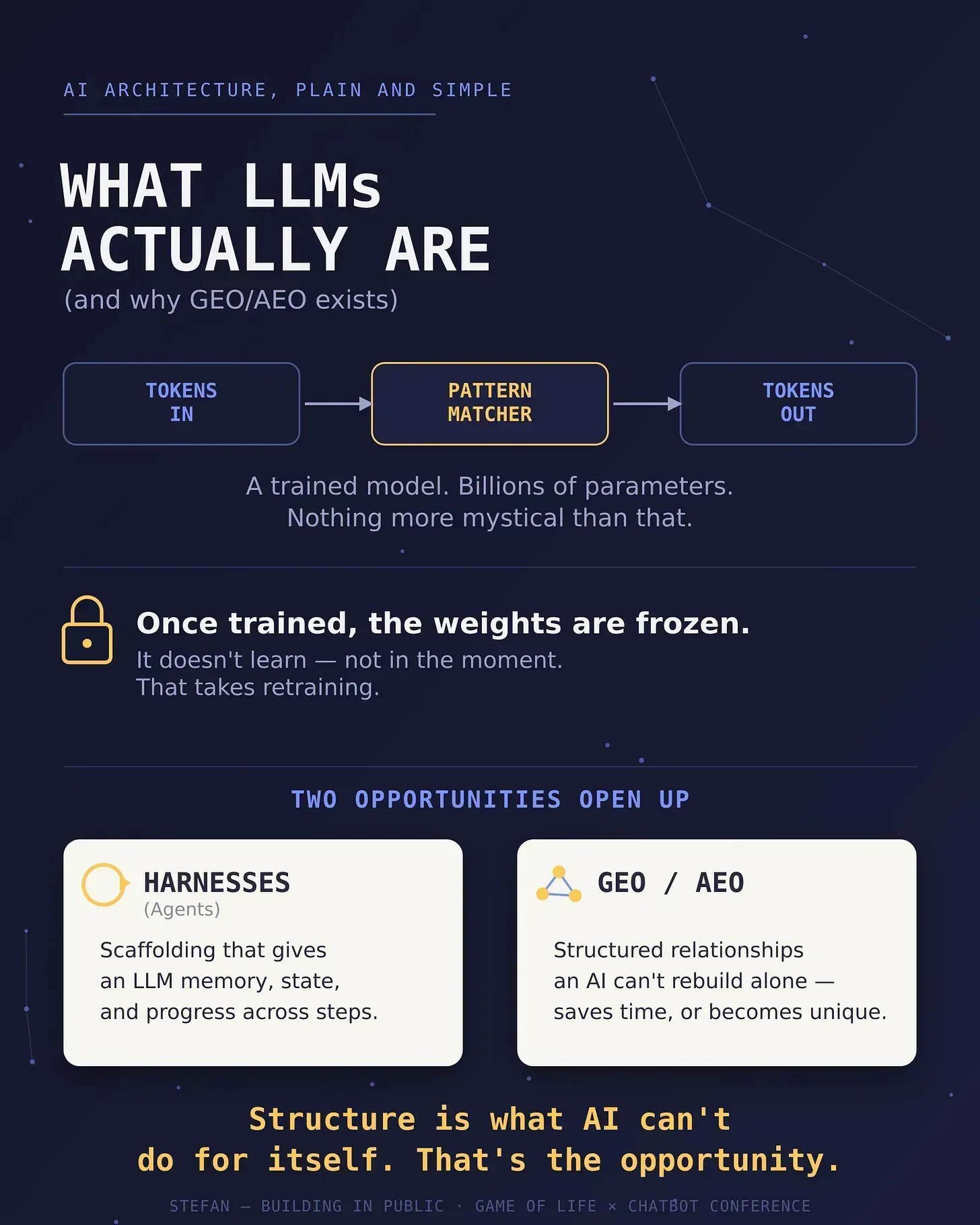
AI is frozen.
It only knows what it was trained on.
It remembers nothing new — every lab on Earth has to retrain just to update what a model knows.
That’s not a bug anyone’s racing to fix.
It’s the nature of the technology.
So to fill the gap, AI reads the live internet the moment you ask it a question and can preform research.
And this has become extremely valuable.
Internet 1.0 was about searching on Google and getting 10 blue links.
Internet 2.0 is about asking AI a questions and it doing Research.
Bot traffic just passed human traffic online for the first time in history
51% of the internet is now automated
(Imperva, 2025).
Now, when AI does its research, it consumes content, your content and can recommend you as the solution provider.
Except not just any content earns that recommendation.
AI doesn’t need another article saying what a thousand other articles already said or what it already knows and has been trained on.
Instead what it needs is content and information that makes the research easier.
Why?
Because doing all of the research on its own is expensive, time consuming and unreliable.
It requires connecting information from multiple domains, determining what is important and valuable and how it relates to user needs.
Which brings us to the actual thesis:
Stop creating content.
Start creating structure.
It’s a much bigger idea in practice, so let’s actually get into what it means, what taxonomy and ontology really are, why AI needs both, and how to build them.
What Taxonomies Are & How to Structure them for AI
You already understand taxonomy, even if you’ve never used the word.
It’s a classification system — categories and subcategories, organized hierarchically.
A library’s shelving system is a taxonomy. Biological classification (kingdom, phylum, class, species) is a taxonomy. An e-commerce site’s “Electronics > Audio > Headphones > Wireless” breadcrumb is a taxonomy.
For a conversational AI or chatbot business specifically, a taxonomy might look like: Industry > Use Case > Tool Type > Feature. It tells you where something belongs. It’s genuinely useful — it’s why my first experiment (a blog organized purely around a detailed taxonomy) went from zero to 8,000 monthly visitors with no backlinks and no promotion.
This is very useful for Ai, because it gives AI all the information about an entity in a highly organized manner. For AI to get all of this types of data, it would need to do a lot of research and then process all of that research by putting it into categories, which is time consuming and expensive.
So when you are creating a AI SEO project, this is the first place to start and that is by creating a very valuable and useful taxonomy for both AI and people.
But a taxonomy has a hard ceiling.
It tells you where something sits.
It doesn’t tell you how it relates to anything else.
What Ontologies are & Why they Matter
An ontology maps relationships.
Not “what category does X belong to,” but “how does X relate to Y, and why does that relationship matter.”
Take the same conversational AI space. A taxonomy tells you a tool is categorized under “Healthcare > Patient Intake > Voice AI.” An ontology tells you that tool is HIPAA-compliant, that it integrates with Epic, that companies using it typically also need a consent-management layer, that teams evaluating it are usually also comparing it against two specific competitors for a specific reason. That’s not a category. That’s a web of meaning — the kind of thing a person with real domain expertise holds in their head, not something you can infer from a folder structure.
This is the part almost everyone skips, and it’s the part that actually matters to AI.
A taxonomy helps a system file something correctly.
An ontology helps it reason — answer the follow-up question, make the right comparison, understand why something is relevant instead of just where it lives.
I tested this.
A well organized blog with a solid taxonomy got me to 8,000 monthly visitors. Solid, but it made something uncomfortable, most if was just articles written by AI, begging the question of why does AI need my content?
So the second experiment went further.
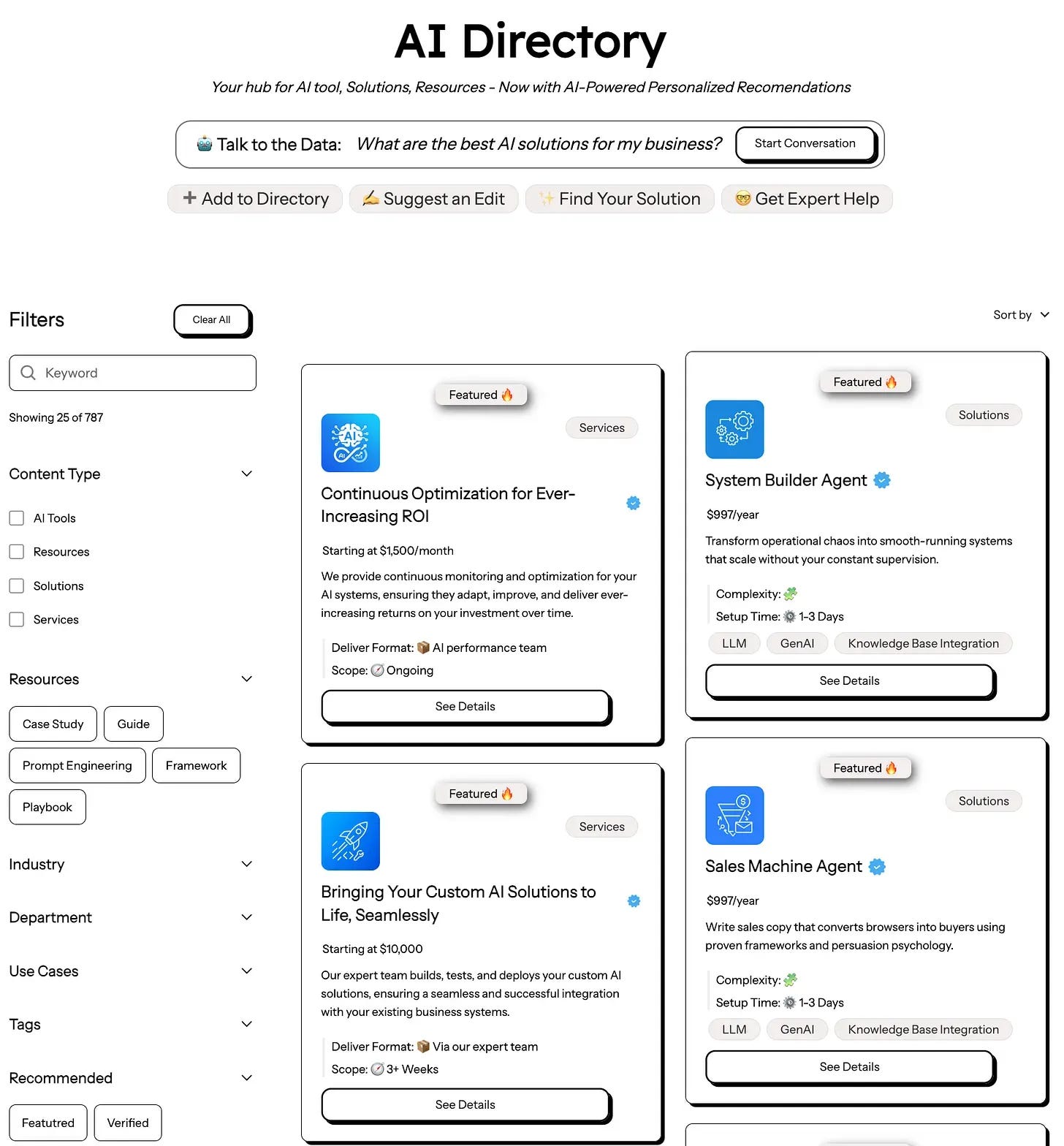
I built an AI Directory — tools, resources, and services organized not just by category, but by the actual relationships between them: industry, department, use case, tag (HIPAA-compliant, for instance), cross-referenced against each other. That’s ontology, not just taxonomy. It grew to 15,000 monthly visitors in a few months, with no promotion, no backlinks — and most of that traffic came from AI itself, not human search.
Same effort level, roughly. Very different structure. That gap is the entire thesis.
How to actually build this
This isn’t abstract. Here’s the real sequence:
Map your entities. What are the actual “things” in your domain — products, services, concepts, people, tools? List them out before you organize anything.
Build the taxonomy. Organize those entities into clear categories and subcategories. This part is mechanical, and most people stop here.
Define the ontology. For each entity, map its real relationships to other entities — not just “belongs to,” but “requires,” “competes with,” “is compatible with,” “is typically used alongside.” This is slower, and it’s where the actual value lives.
Structure it so AI can read it. Schema markup, structured data, a real database — not a wall of prose. AI needs to be able to parse the relationships, not infer them from paragraphs.
Use agents to build and maintain this at scale. Manually maintaining a real ontology doesn’t scale past a certain size. This is exactly what agent systems are for — not writing more content, but keeping the structure itself current as your domain changes.
Where this is going
I’m building exactly this, live, for Game of Life — an AI agent whose entire job is applying this same taxonomy-plus-ontology approach to get the platform found and cited by AI search, not just ranked by Google.
If you want to watch the build, ask questions, and see it happen in real time, join The Loop — free, monthly, live on Zoom. If you want to build your own version, hands-on, from scratch: the 3-day workshop this November is exactly that, start to finish.
Either way, the underlying bet is the same one this whole piece has been making: the businesses that structure what they know in the next year get a real, compounding advantage over the ones still just publishing more.