


I’ve spent close to a decade watching this industry build conversational AI, first through Chatbots Life, then running the Chatbot Conference.
In that time I’ve seen every flavor of “we built an AI”, most of which turned out to be a single prompt with a system message doing a lot of hoping.
So when I started building Game of Life, an AI-powered psychological development platform, I did just that, build a single Agent with a great system message using a powerful model and watched it completely fail.
Then I started to think about why it was failing, where it was failing, and began imagining potential solutions. First, I wanted to simplify what the AI was doing, so no more one massive system prompt. Then I wanted a dependable way to mange the context and this naturally led me to building Ai agents.
The AI agent, took four shapes and as it turns out almost these are the same four shapes that everyone talks about: Agents, Graphs, Loops and Automations.
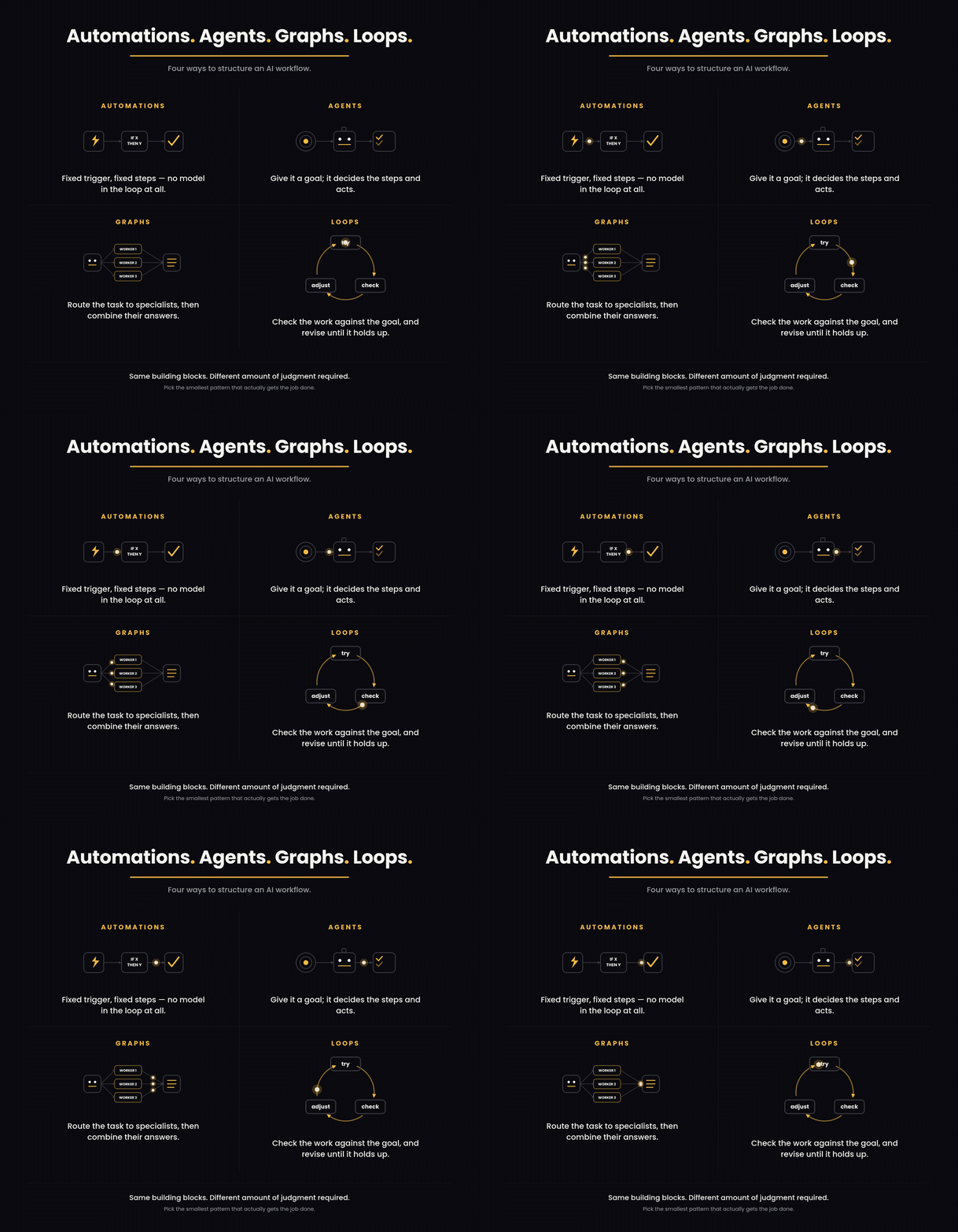
Below is a quick overview of each of these core four pattern of building AI Systems and how we use them in the Game of Life.
Automations: the unglamorous workhorse
Automations have been around the longest via tools like n8n, Make, Zapier, and now with Claude Code a new opportunity has emerged: personalization.
This is how we are using automations.
Depending on how someone moves through the site — which pages they land on, which of our AI agents they talk to, how many times — they get a custom email sequence introducing them to the parts of the app most relevant to them.
No model makes a judgment call at send time.
The trigger fires, the rule resolves, the email goes out. It’s the least interesting pattern in the stack.
But there is one more thing. Sometimes, those emails are themselves writteden personalized by AI.
Now, you may wonder, is adding an LLM to a step make the system an agent?
No, because the LLM is not deciding anything.
AI Agents
ARIA, the conversational layer people actually talk to, looks from the outside like a single chat interface.
It isn’t.
She’s has a set of goals and decides in real time how hard to push, when to sit still, when to invite the next step.
That’s the actual definition of an agent worth using: given a goal and some tools, it decides the steps and adapts as it goes, rather than following a script someone wrote in advance.
Underneath her sits a small multi-agent system most users never see:
A Director agent tracks where the conversation is in its arc — has enough ground been covered, is the person engaging or deflecting, is it time to advance — and updates that state after every turn.
A separate Summary agent maintains rolling context so long conversations don’t quietly lose their thread. Both run on a smaller, faster model than the one doing the actual talking, on purpose. Tracking state is not the same job as exercising judgment, and it doesn’t deserve your most expensive model’s attention.
AI Graphs
While someone is talking to ARIA, there’s an entire structure running in the background assessing their psychology.
This is the graph layer, and it’s where most of the actual complexity in the system sits.
Multiple analysts read the same material and independently analyze specific structures — personality, values, belief patterns, character — forming and testing hypotheses against instruments that are actually validated, not invented for the occasion.
Their reads get compared, not simply averaged. Disagreement between them is signal, something to be tested.
This is also the part of the architecture that is most essential. Yes, it’s slower and more expensive than asking one model for its opinion and shipping the response but its instead far more accurate, graceful and helpful.
AI Loop
Loops are the pattern everyone gets excited about once they’ve built the other two: an agent that runs, checks its own output against some criteria, and revises until it passes. They’re genuinely powerful, and I’m not skeptical of them in general. I’m skeptical of them in this specific domain, for a specific reason.
Loops work beautifully when “correct” is checkable by something outside the model’s own opinion. Code that runs. Tests that pass. A build that compiles. In those cases the loop is bounded by reality — the model can be wrong about its own progress, but the compiler isn’t going to be talked into agreeing with it.
Psychological judgment doesn’t have that checker. It’s far more nuanced and up for interpretation.
There’s no compiler for “is this an accurate read of someone’s character structure.” So an agent looping on its own psychological read isn’t converging toward truth — it’s converging toward whatever satisfies its own rubric, and a confidently wrong convergence sounds exactly as certain as a correct one.
That’s the one failure mode I don’t think this domain can absorb, so for now, the graph does the work a loop would otherwise be tempted to do alone: instead of one perspective revising itself into agreement with itself, we keep multiple independent perspectives that are allowed to disagree.
Where we plan to Use Loops in the Future
That said, I don’t think loops are wrong for us and I believe we’ve found that place: AI SEO.
Imagine an AI-SEO/GEO project running in parallel, where a background agent generates content and a loop can verify it against something genuinely checkable — did the claim resolve, does the structure parse, is the fact actually sourced — before it publishes.
Low stakes, real checker, no psychology involved.
That’s the proving ground, and if it earns our trust there, it’s a much shorter walk from a content pipeline into the parts of the product where the stakes are higher.
I’m building this in the open through the rest of the year — architecture, product decisions, and the mistakes along the way.
If you want to watch the build, ask questions, and see it happen in real time, join The Loop — free, monthly, live on Zoom. If you want to build your own version, hands-on, from scratch: the 3-day workshop this November is exactly that, start to finish.
Either way, the underlying bet is the same one this whole piece has been making: the businesses that structure what they know in the next year get a real, compounding advantage over the ones still just publishing more.